An Educational Dolphin Tour
Featuring Insights from Captain Chad, USCG Master Captain
Some dolphin tours are a fun boat ride. Ours are something more.
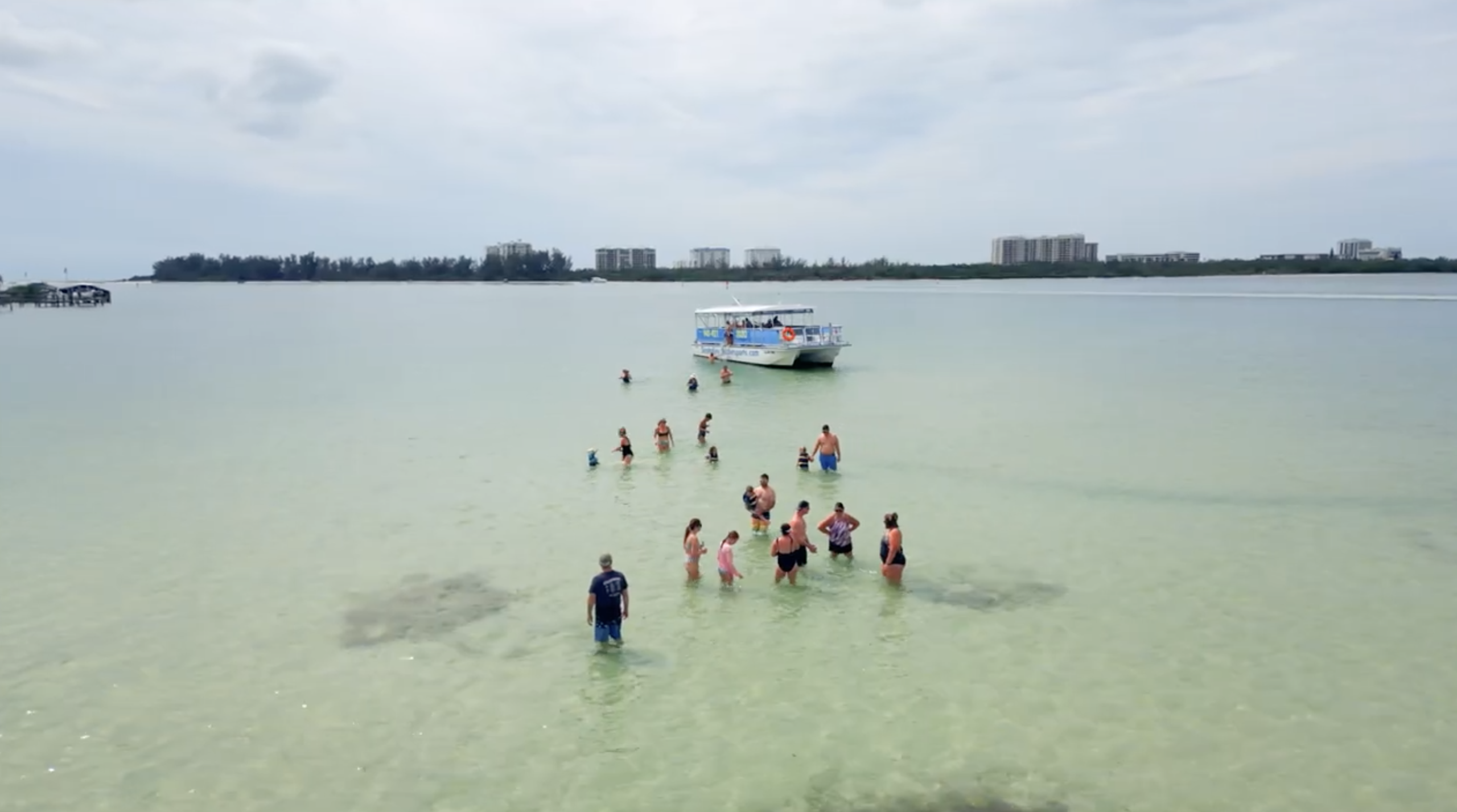
Step aboard our 50 foot Corinthian catamaran, custom built specifically for us and designed for passenger tours, comfortably welcoming up to 49 guests. You immediately feel the difference. The twin hull design creates a wider, more stable ride than a traditional single hull vessel, reducing rocking and providing a smooth experience as we move through the channel and into the Gulf.
There is wide open deck space, comfortable seating, room for kids to move safely, and a restroom onboard for convenience. Clear sightlines from every angle ensure no one misses a dolphin surfacing nearby.
It was purpose built for coastal sightseeing, designed for families, for celebrations, and for generations. And you can feel it the moment you step aboard.
And then there is Captain Chad.
We like to joke that he was born in the 1900’s. He was not around when John Ringling was shaping Sarasota in the early 1900’s, but his knowledge of these waters runs deep. As we cruise through the intracoastal waterway and in the bays, he shares the kind of insight that changes the way you see this coastline.
Dolphins in Their Natural Habitat
“These dolphins live here,” Chad explains as we move toward open water. “They are residents.”
Guests learn that dolphins can live for decades. Their skin appears shiny because it is constantly shedding. They use echolocation to navigate and hunt. Mothers and calves communicate in unique ways to stay connected.
They sleep with half their brain at a time. They are intelligent, social, and wild.
We observe respectfully. Always.
Some days they ride the wake. Some days they surface quietly in the distance. Wildlife moves on its own rhythm, and part of stewardship is respecting that.
Through the Channel and Into the Gulf
As we pass the channel markers, Chad explains navigation.
“Think of them like guideposts,” he says. “Stay between them and you are in safe water. Drift outside and it gets shallow fast.”
Channel markers function like mile markers, though not exactly one mile apart. Red markers outline the mainland side of the United States.
Outside the channel, depths change quickly. Grass flats are beautiful but shallow.
“Those grass flats are nurseries,” Chad adds. “They protect marine life. We respect them.”
Once we clear the pass and enter the Gulf, the horizon opens wide.
“That is when people get quiet,” Chad says with a smile. “You can feel the difference.”
Coastal Birds and the Robarts Bay Rookery
Near the Robarts Bay rookery, Chad slows the tone.
“This is one of the largest nesting areas in our region,” he explains. “It may look quiet, but it is busy up there.”
Brown pelicans can live more than 15 years. Juveniles are dark brown. Adults develop lighter heads and necks. Guests quickly learn to spot the difference.
We also identify white egrets, snowy egrets, great blue herons, cormorants, and roseate spoonbills.
During nesting season, we keep our distance.
“If we disturb them, they burn energy they need for raising chicks,” Chad says.
And one rule we repeat often.
Do not feed wildlife!
Manatees and Mangroves
Manatees are often present in spring, summer, and fall when waters are warmer.
“They are bigger than most people expect,” Chad says. “Over ten feet long, sometimes more than a thousand pounds.”
Gentle giants that require patience.
Cory, our first mate, scans the water and adds, “If you see a swirl near the surface, slow down and give them space.”
Three types of mangroves line our shoreline. Red mangroves are easily recognized by their exposed root systems.
“These roots are nurseries,” Cory explains. “So much life starts here.”
By the end of the tour, guests begin noticing details they might have missed before.
A Little Local History
As the coastline comes into view, Chad points toward shore.
“Sarasota did not always look like this,” he says.
In the early 1900’s, John Ringling and the Ringling Circus helped put Sarasota on the map.
“These waters have been part of the story the whole time,” Chad explains. “Boats were moving through here long before dolphin tours.”
If you are visiting, The Ringling Museum is worth exploring during your stay.
History runs deep here. On land and on the water.
More Than a Boat Ride
We see it on every trip.
A child asking questions about pelicans. A grandparent explaining channel markers. A couple quietly watching the horizon.
It starts as a boat ride.
Somewhere between the channel and the Gulf, it becomes something more.
Guests leave seeing the water differently. Not just entertained, but aware. If you step off the boat thinking twice about wildlife and respecting these waters, then you have become a steward of the water.
And that is why we love what we do!
When your office is the Gulf and your days are spent sharing it with others, it never really feels like work.
Come aboard and experience one of the most educational and engaging dolphin tours in Siesta Key.