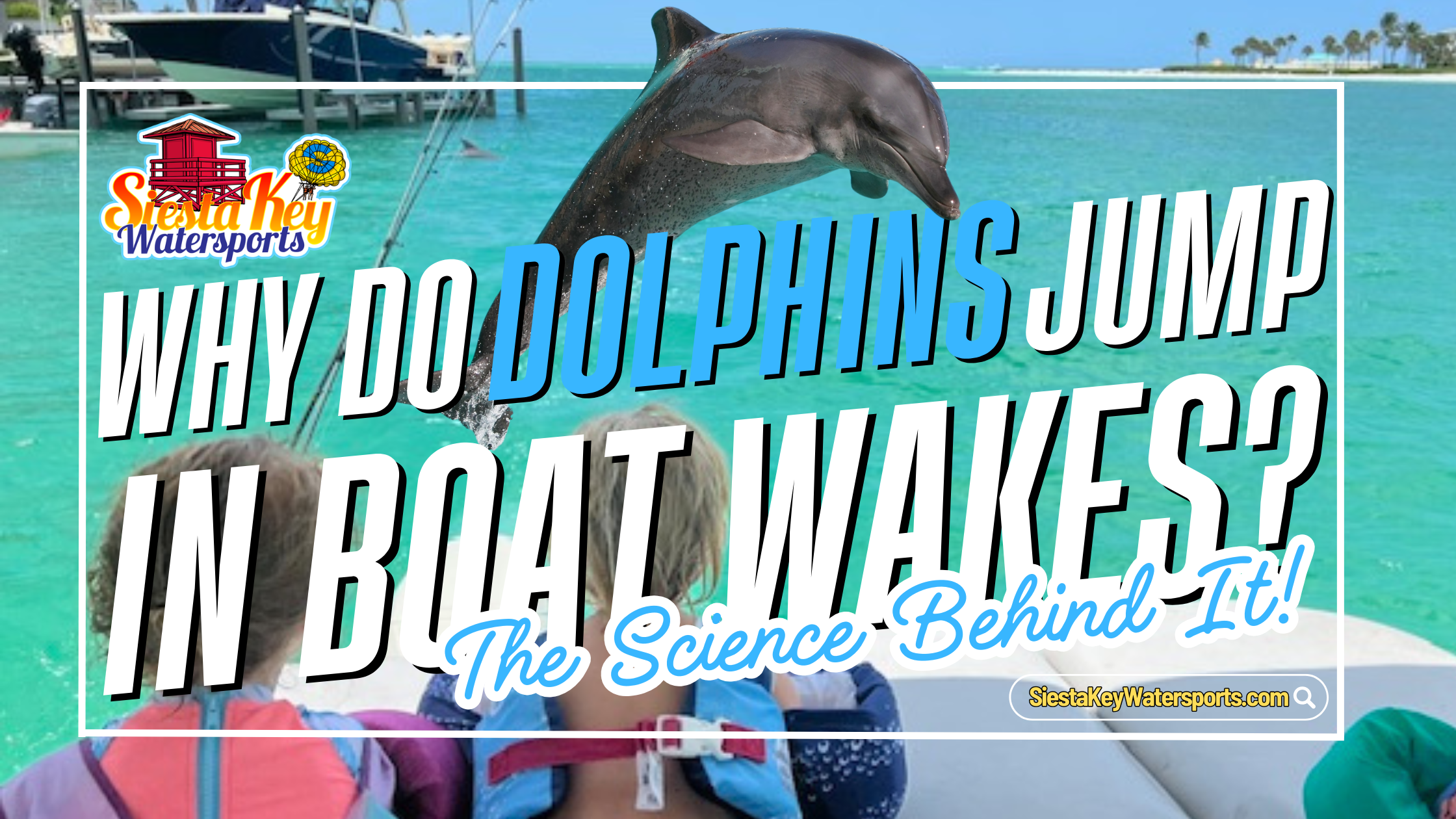
If you’ve spent time boating around Sarasota, Siesta Key or the Gulf, there’s a good chance you’ve seen it. A bottlenose dolphin appears alongside or behind a moving boat, begins riding the waves created by the vessel and sometimes launches completely into the air.
We see this fairly often at Siesta Key Watersports, especially behind our parasail boats. It’s incredible to watch, but there’s actually quite a bit more happening than simply a dolphin following a boat.
So why do dolphins ride boat wakes? Does it make swimming easier? Why do dolphins jump out of the water? And are they actually having fun.
Meet Sarasota’s Bottlenose Dolphins
Sarasota isn’t just an incredible place to encounter bottlenose dolphins. It’s also home to one of the most remarkable wild dolphin research programs in the world.
The Sarasota Dolphin Research Program at Mote Marine Laboratory & Aquarium began in 1970 when researchers set out to answer a simple question: Did the dolphins of Sarasota Bay live there year-round, or were they simply passing through? They discovered a community of long-term resident dolphins that called Sarasota Bay home across decades and generations.
Today, the program is the world’s longest-running dolphin conservation research program. Its research gives scientists a rare opportunity to follow known individual dolphins and family lines over many years.
One important distinction: not every dolphin we encounter around Sarasota or offshore in the Gulf is necessarily part of that long-term Sarasota Bay resident population. Our local waters are part of a much larger coastal ecosystem, and bottlenose dolphins can be encountered throughout Sarasota’s bays, passes, nearshore waters and the Gulf of Mexico.
Why Do Dolphins Ride Boat Wakes?
There’s some fascinating science behind it. When a boat moves through the water, its hull displaces water and creates waves and areas of changing pressure around the vessel. A dolphin that positions itself correctly can take advantage of that moving water, much like a surfer catching a wave. The dolphin is still controlling where it’s going, but the moving water can help carry it forward.
You’ll often hear two terms used to describe this behavior. Bow-riding happens when dolphins ride the pressure wave near the front of a vessel, while wake-riding happens when dolphins use the waves created behind it.
And scientists have actually measured the energetic benefit of this behavior.
Do Dolphins Ride Boat Wakes to Save Energy?
Research suggests they can. A 2024 study published in Scientific Reports compared dolphins swimming freely with dolphins bow-riding a research vessel and found that respiration rates were lower in bow-riding dolphins traveling at comparable speeds.
At speeds greater than 4 meters per second, respiration rates of bow-riding dolphins were about 45% lower. That’s wild! The researchers concluded that the results support the energy-saving hypothesis: dolphins can take advantage of pressure waves produced by vessels and reduce the energetic cost of traveling quickly.
The study also notes earlier research involving bottlenose dolphins that found similar energetic savings during wake-riding.
Read the 2024 Scientific Reports study on the energetic savings of bow-riding dolphins
So when a dolphin seems to find the perfect spot alongside or behind a moving boat and effortlessly stays there, some impressive hydrodynamics may be happening beneath the surface.
Do Dolphins Surf Boat Wakes for Fun?
Possibly. Scientists have debated the reasons dolphins bow-ride and wake-ride for decades. One explanation is energy efficiency. Another possibility is play.
In fact, the 2024 Scientific Reports study notes that bow-riding has been proposed as a form of play and that energy savings and play are not necessarily competing explanations. A dolphin may benefit from the moving water while also participating in social or playful behavior.
That doesn’t mean we can look at every dolphin riding a wake and confidently say, “That dolphin is having fun.” Wild animal behavior has to be interpreted in context, and we can’t know exactly what an individual dolphin is thinking. But dolphins are highly social animals, and play is a recognized part of their behavior.
So yes, there is real science behind what looks a whole lot like surfing. And sometimes they certainly look like they’re enjoying the ride. We like to think they’re having a blast!
Why Do Dolphins Jump Out of the Water?
There isn’t one single reason dolphins jump. They leap from the water during a variety of behaviors, including travel, social interactions and play. You’ll also hear terms such as breaching, leaping and porpoising used to describe different forms of movement at or above the surface.
At higher swimming speeds, dolphins may alternate between swimming below the surface and traveling through the air. Jumping and re-entering the water can also create sound, which may play a role in social behavior or communication.
One spectacular jump doesn’t necessarily tell us exactly why that animal jumped. But when you’re watching a dolphin repeatedly approach a moving vessel, use its waves and launch through the wake, you’re seeing an incredible combination of swimming ability, hydrodynamics and natural wild behavior happening right in front of you.
Why Do Dolphins Follow Boats?
Sometimes dolphins simply choose to approach a moving vessel. That’s an important distinction.
A dolphin choosing to approach a boat does not mean boaters should chase or crowd dolphins. Wild dolphins are protected under the Marine Mammal Protection Act, and NOAA Fisheries’ Marine Life Viewing Guidelines recommend observing dolphins from at least 50 yards away.
If dolphins approach a vessel on their own, that’s different. They’re making the decision. We don’t feed dolphins or chase them. Sometimes they simply decide to join us, and that’s exactly what makes those moments so special.
You can learn more about responsible viewing through NOAA Fisheries’ Protect Wild Dolphins resources.
Are There Dolphins Around Sarasota Year-Round?
Yes. Bottlenose dolphins can be found in Sarasota’s coastal waters throughout the year, from bays and passes to the nearshore Gulf of Mexico.
Mote’s Sarasota Dolphin Research Program has studied a community of long-term resident dolphins in Sarasota Bay for more than five decades, following known individuals and family lines over time. But not every dolphin we see around Sarasota necessarily belongs to that resident population. Some may range more widely through Sarasota’s coastal waters and the Gulf.
Researchers can often identify individual dolphins by the unique shape, scars and markings on their dorsal fins, helping scientists track where known animals go and how they use different parts of our coastal ecosystem.
Where Can You See Dolphins and Wildlife in Sarasota?
Wild bottlenose dolphins can be encountered throughout Sarasota’s coastal waters, from Sarasota Bay and the waters around Siesta Key to our passes and the nearshore Gulf. At Siesta Key Watersports, where we see them depends on the day, the trip and the conditions.
And there’s one word that matters most when we’re talking about dolphin sightings: wild.
There are no scheduled appearances. No guarantees. Our local dolphins are not paid staff. Some days we see mothers with calves, dolphins feeding or groups traveling together. Other days we get a quick glimpse. And every once in a while, one decides our wake looks like a pretty good place to surf.
Dolphins aren’t the only wildlife out here either. Depending on the day, we may encounter manatees, stingrays, ospreys, eagles, egrets, roseate spoonbills and plenty of other animals that call Sarasota’s coastal ecosystem home.
If wildlife and marine life are part of your Sarasota vacation, we also highly recommend adding the new Mote Science Education Aquarium (Mote SEA) to your itinerary. It’s a great way to learn more about the marine life and science happening right here in Sarasota, and an especially good option when Florida weather changes your outdoor plans.
See Sarasota wild with us. Then visit Mote to dive even deeper into the incredible wildlife, marine life and ecosystems that make Sarasota so special.
Why We Still Get Excited
After more than 20 years of operating on Sarasota’s waterways, you’d think seeing dolphins would eventually become normal. It doesn’t.
We can’t schedule a dolphin encounter, guarantee one or tell a wild dolphin what to do. So when one suddenly launches out of the water behind the boat, our guests aren’t the only ones yelling. Our captains and crew still get excited too.
You can plan the boat ride. You can’t plan the dolphin that decides to come along for it.
Frequently Asked Questions About Dolphins in Sarasota
Why do dolphins swim next to boats?
Dolphins may choose to swim alongside moving vessels and can take advantage of pressure waves generated by a boat. Research suggests bow-riding and wake-riding can reduce the energetic cost of swimming at higher speeds.
Why do dolphins jump in boat wakes?
There isn’t one explanation for every jump. Dolphins leap during travel, social behavior and play. When dolphins are riding vessel-generated waves, jumping may occur as part of their movement or behavior while interacting with the wake.
Do dolphins actually surf?
In a sense, yes. Dolphins can position themselves in waves and moving water and use that energy to help propel themselves, similar to the way a surfer uses the energy of a wave.
Are there bottlenose dolphins in Sarasota year-round?
Yes. Bottlenose dolphins can be found in Sarasota’s coastal waters throughout the year. Sarasota Bay also supports a well-studied community of long-term resident dolphins researched by Mote’s Sarasota Dolphin Research Program.
Do dolphins live in the Gulf of Mexico near Sarasota?
Yes. Bottlenose dolphins occur in Gulf of Mexico coastal waters, including nearshore waters off Sarasota and Siesta Key.
Can you see dolphins near Siesta Key?
Yes. Wild bottlenose dolphins can be encountered in the waters around Siesta Key, Sarasota’s passes, nearby bays and the nearshore Gulf of Mexico. Because they’re wild animals, sightings and behaviors can never be guaranteed.
Should you approach dolphins when boating?
Give wild dolphins plenty of space and let them choose the interaction. NOAA recommends remaining at least 50 yards away when viewing dolphins and advises boaters not to chase them or intentionally create pressure wakes to encourage bow- or wake-riding.
When we spot dolphins, we may carefully position our vessel for a better view while maintaining a safe and respectful distance. The dolphins you see up close in our videos are approaching our vessels on their own. When they do, we remain at idle and let them decide where they want to go.
That’s the best part of seeing wildlife in the wild. They’re in charge.
Can dolphins get hurt by boats?
Yes. Dolphins, manatees and other wildlife can be seriously injured or killed by vessel strikes and propellers. That’s one reason responsible boating matters so much in Sarasota’s wildlife-rich waters.
Boaters should always follow posted speed zones, including Idle Speed No Wake and Slow Speed Minimum Wake zones, as well as seasonal or posted manatee protection zones. These terms don’t mean exactly the same thing, and knowing the difference helps protect both people and wildlife.
We’ll be diving deeper into Sarasota’s boating and manatee zones in an upcoming article.
Learn More About Sarasota’s Dolphins
We’re incredibly fortunate to operate in a community where scientists have been studying wild dolphins for more than half a century. If this fascinates you as much as it fascinates us, explore the Sarasota Dolphin
Research Program at Mote Marine Laboratory & Aquarium. Their work has helped scientists understand dolphin biology, behavior, health, ecology and conservation here in Sarasota and far beyond it. You can also learn more about enjoying dolphins responsibly through NOAA Fisheries’ Marine Life Viewing Guidelines.
And if you’d like to experience Sarasota’s coastal waters for yourself, Siesta Key Watersports offers Dolphin & Wildlife Discovery tours, dolphin and sandbar cruises, sunset cruises, private charters, parasailing and more.
This article is also a small glimpse of the more educational side of Siesta Key Watersports. We have much more to share soon.
The more we understand our waterways, the better we can enjoy them safely and protect what calls them home.